
| Dedication: | St.Ladoca | |
| District: | Central | |
| Bells: | 8 bells. 11-1-1 (572kg) in Ab | |
| Practice Night: | Wednesday 19.30 (1st & 3rd) | |
| Sunday Ringing: | 10:30am (1st and 3rd) | |
| Location: | Grid Ref. SW894509 | |
| Postcode: | TR2 4PL | |
| Dove: | Ladock | |
| Peals: | Ladock Peals | |
https://www.ladockchurch.org.uk/
Hear the bells – ringing Stedman triples
Ladock Bells Restoration
“Ooo they’re the worst bells in Cornwall” was the response I got when I first said I was moving to Ladock. They can’t be that bad I thought… and they weren’t. A bit out of tune, a bit of a challenge to ring, a bit oddstrock and long draft all added up to a set of bells that were far from optimum and maybe some of the worst bells in Cornwall.
Since then the ringing room has been moved upstairs creating a kitchen and toilet below and some minor work was carried out in 2014, things barely improved.
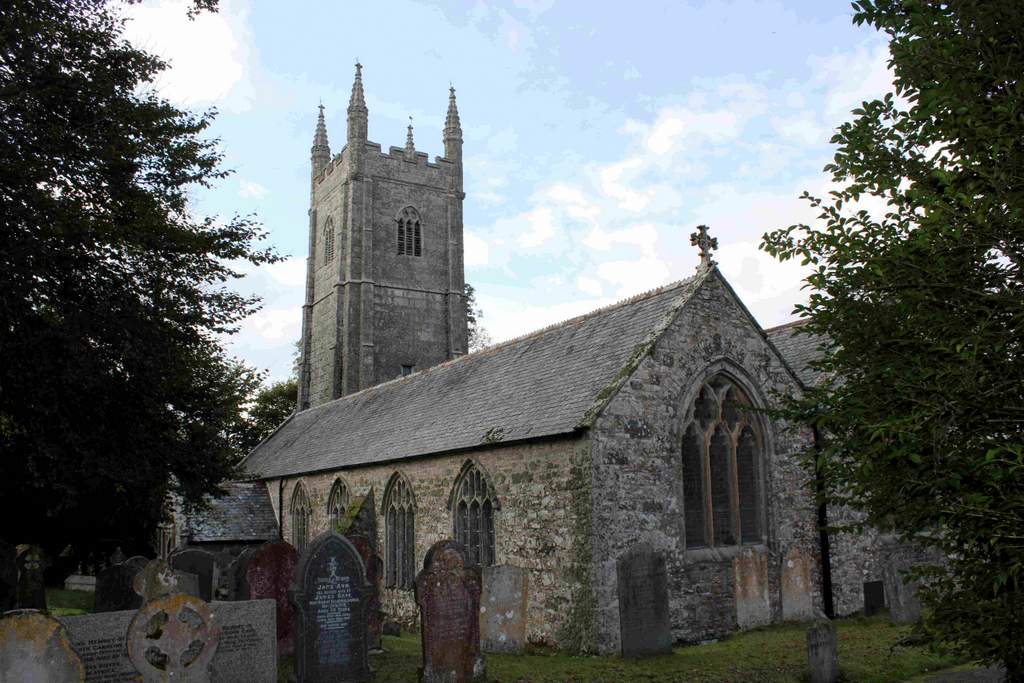
To understand how we got here we must first look at the history of the parish and bells. Ladock church was the parish church for a number of hamlets including Bissick, a milling village at the bottom of the hill below the church. It wasn’t until the building of the toll road from Tresillian to Brighton Cross and beyond did Ladock start to grow being now on a major traffic route. A rectory was built and the then three 17th and 18th century bells called people to worship. By the mid-17th century the church was in a sorry state of affairs not reflecting the now burgeoning parish.
All this changed when Richard Farquar Wise became Rector in 1846. Son of a Camborne doctor and a man of considerable wealth, he set about extending the rectory and restoring the church from his own money. No expense was spared with renowned London architect G E Street overseeing the work with stained glass windows from the studio of William Morris. The church was rededicated in 1864 to much praise, with the exception of the bells which Wise had not altered.
The Royal Cornwall Gazette 22nd January 1864 reports:
…but all those whom we saw listening with such evident delight to the reopening of their parish church on Sunday morning , must have been painfully conscious of the miserable, inefficient and unmusical peal of bells which struggled to emit a joyful song upon the occasion.
It is likely that Wise, upon his arrival, set to work on the most serious issues with the church which included a leaking roof and a perilous north wall that had fallen rather than such fripperies as bells. Over the next 15 years or so the parish raised two thirds of the cost of 6 new bells and the order placed with William Aggett 1883. Canon Wise donating the remaining money.
It was Aggett who placed the order to John Taylor & Co. and his name appears as the sole donor of the 6th bell suggesting he was personally invested in the project. Aggett installed the oak frame in the tower and included his headstocks, wheels and bearings. The smaller bells, as was the practice of the time, were cast with canons whilst the two tenors flat topped. Cast Iron frames were becoming available from Taylors at this point but this was not Aggett’s trade and such would not have been to his specification.
Aggett installed an 8-bell frame in preparation for two further bells but the church had to wait 42 years before Taylors supplied two trebles. In the intervening period technology of bell manufacturing had moved on with small bells cast without canons using modern, harmonic tuning.
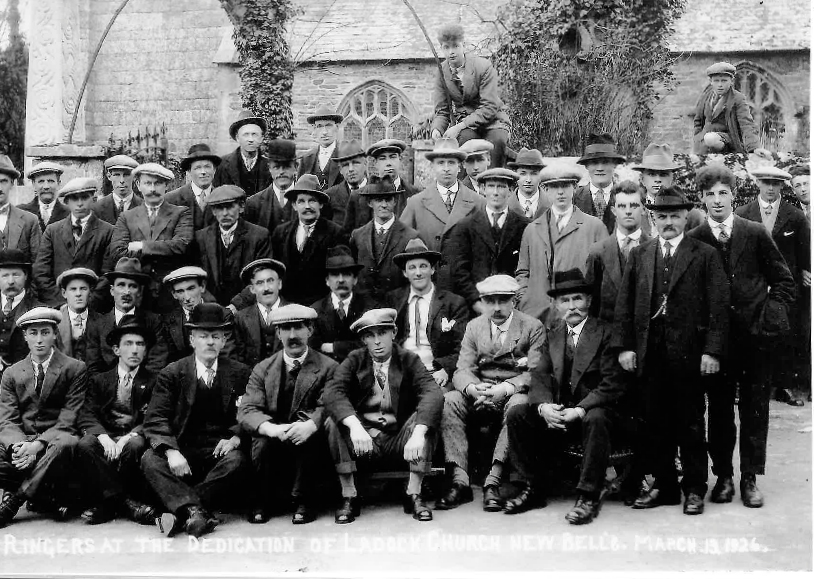
A report of the dedication of the trebles in the Friday March 19th 1926 Western Times stated the ring of eight ‘…are claimed to be one of the finest in the Truro District’ and ‘…are hung on modern principles, with patent adjustable bearings..’
Unfortunately even then the finished article was far from this, and it is these bells we know and love today. The tonal difference between the good 1925 2nd and poor 1883 3rd is significant and the middle four bells, in general, are ‘not good examples of their craft’.
At some point in the 1930s the frame was found to be moving such that wooden wedges were installed transferring movement and force into the north wall of the tower. Lucky, unlike the bells, the tower was, and is, in good shape.
Things got so bad that by the 1970 the locals took it upon themselves to rehang the bells and plain out some of the frame to level up the swing of the bells. They replaced the ‘patent adjustable’ Aggett bearings with (very probably) ‘stuff from around the farm workshop.’
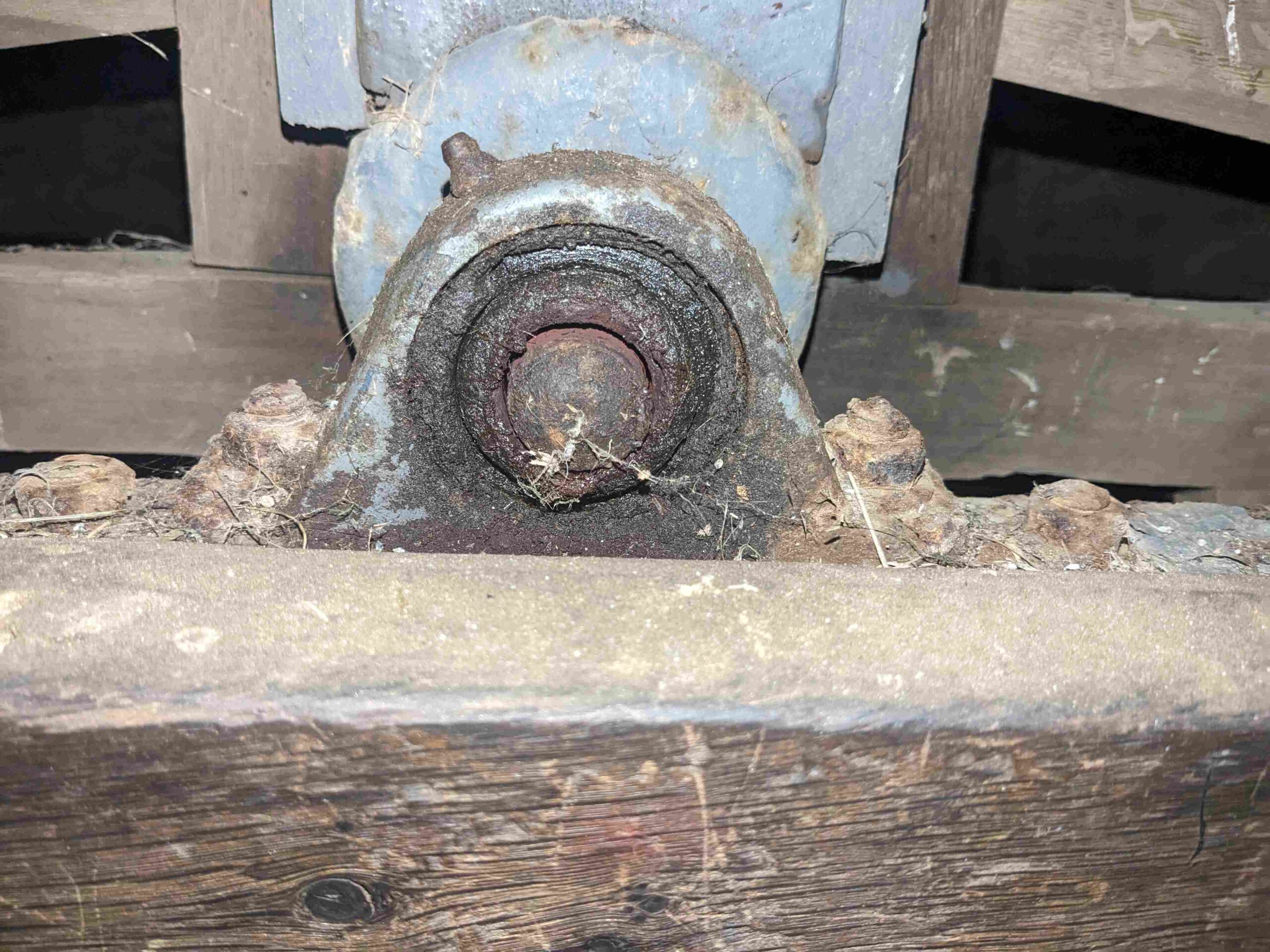
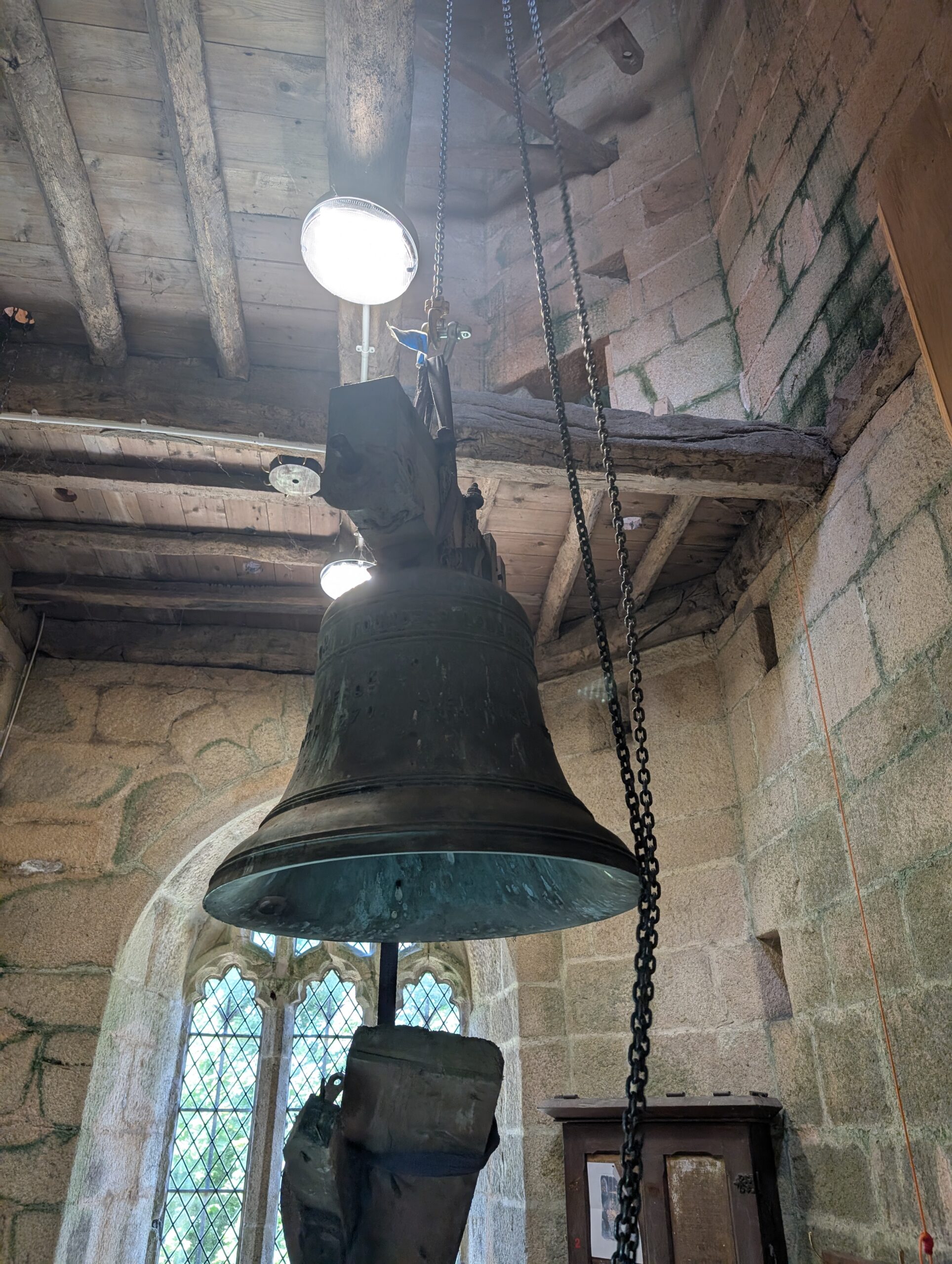
Unsurprisingly by 1985 the bells were again verging on unringable and fundraising was carried out for another attempt at rehanging. This time Arthur Fidler was commissioned to do the work and he rehung the bells on new fittings. Anyone with knowledge of Fidler’s work will know he was not one for conforming to practices of the time, and he put small open-sided bearings on the bells fixed to the same 1883 gudgeons (see photo below). Of course with any new technology comes uncertainty and the lifetime of Fidlers setup was unknown particularly given he had left significant parts of the original unsuitable fittings.
In 2014 Nicholson fitted new pulleys in another attempt to improve things, but in all of these cases we were simply applying sticky plasters to a job that was never right in the first place.
The go of the bells was always far worse in the winter when the frame contracted and warped, pinching the bearings and making the pulleys seize. It was a January practice in 2024 that put the final nail in the coffin. Missed sallies, the 7th being particularly awkward and not much fun being had by anyone. I raised the question on should we look at doing something more substantial to the bells… before I’d finished the sentence Renfree, a ringer at Ladock for over 70 years, said ‘yes we should.’
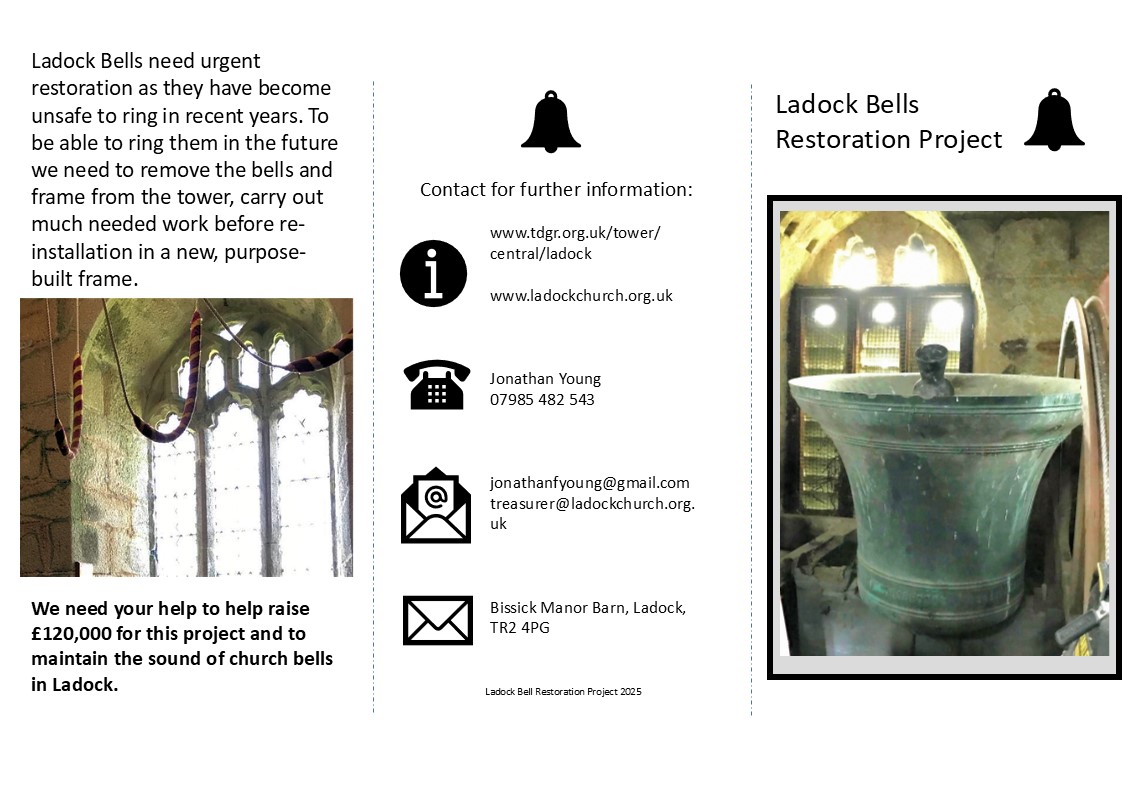
I presented our issue to the church warden, PCC treasurer and then to the wider PCC. All were in favour of carrying out the work and would support a fundraising effort. Taylors, Nicholson’s and Whites all visited and gave reports and quotes and all broadly agreed the frame was past it, the bells 3-6 was tonally deficient and, because of their profile and weight, would not be able to be tuned to satisfactory condition without compromising power or structural integrity.
During the first inspection by Taylors, on test ringing the most difficult 7th bell, we discovered a broken gudgeon. On any normal ring of bells this would have been noticed straight away rendering the bell almost unringable… but our 7th has always been a challenge and we hadn’t noticed.
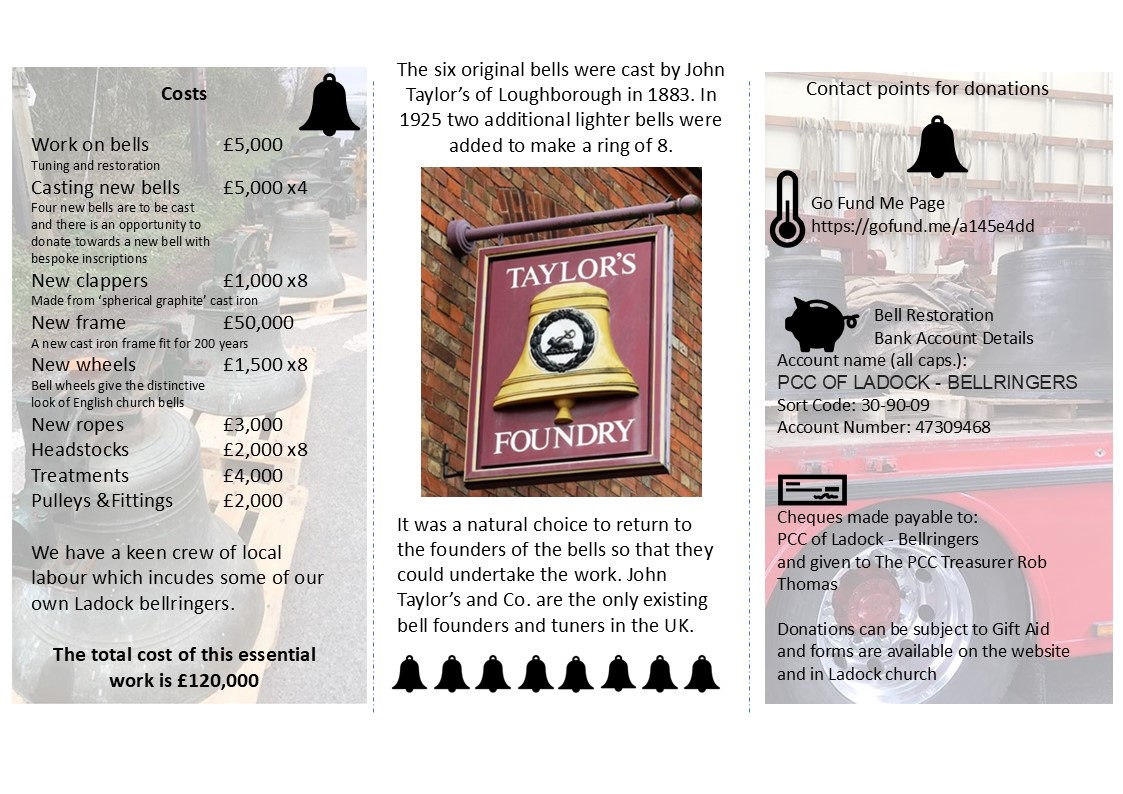
From the outset we decided that we wanted our 11cwt ring of 8 bells to remain a ring of 8. Adding more bells means adding more ringers, there were no silly ideas of augmentation. Furthermore with 1 and 2 being tonally very good and the 7 and 8 being of suitable size to allow tuning to a good 10-2-0 tenor we believe we should get an ideal light ring of 8. Due to the compromises over retuning the middle bells we have opted for 4 new bells to replace these. The bells will be housed in a purpose-built, cast-iron Taylor bell frame on a single level.
Fundraising is now well underway. We’re working to a tight deadline and hope to have the bells out of the tower by the end of June in time for our village fete. We plan to display the bells in the church for a few weeks before sending them to the foundry. Ladock school is immediately next door and use the church for assembly twice a week, having all 8 bells on display for them and the rest of the village will serve as good publicity.
One of my key principles of this project is to raise the awareness of the bells as an important aspect to community and village life, and not just as a church asset. If we can harness the enthusiasm an energy from the village and parish we will hopefully get another generation of ringers on some vastly improved bells at Ladock.
Should you feel moved to make a gift towards the project at this time, relevant bank details are: Account name: PCC OF LADOCK – BELL RINGERS; Sort code: 30-90-09; Acct. No: 47309468.
Use this link to find recordings of many of Truro Diocesan bells

GoFundMe
https://gofund.me/a145e4dd
